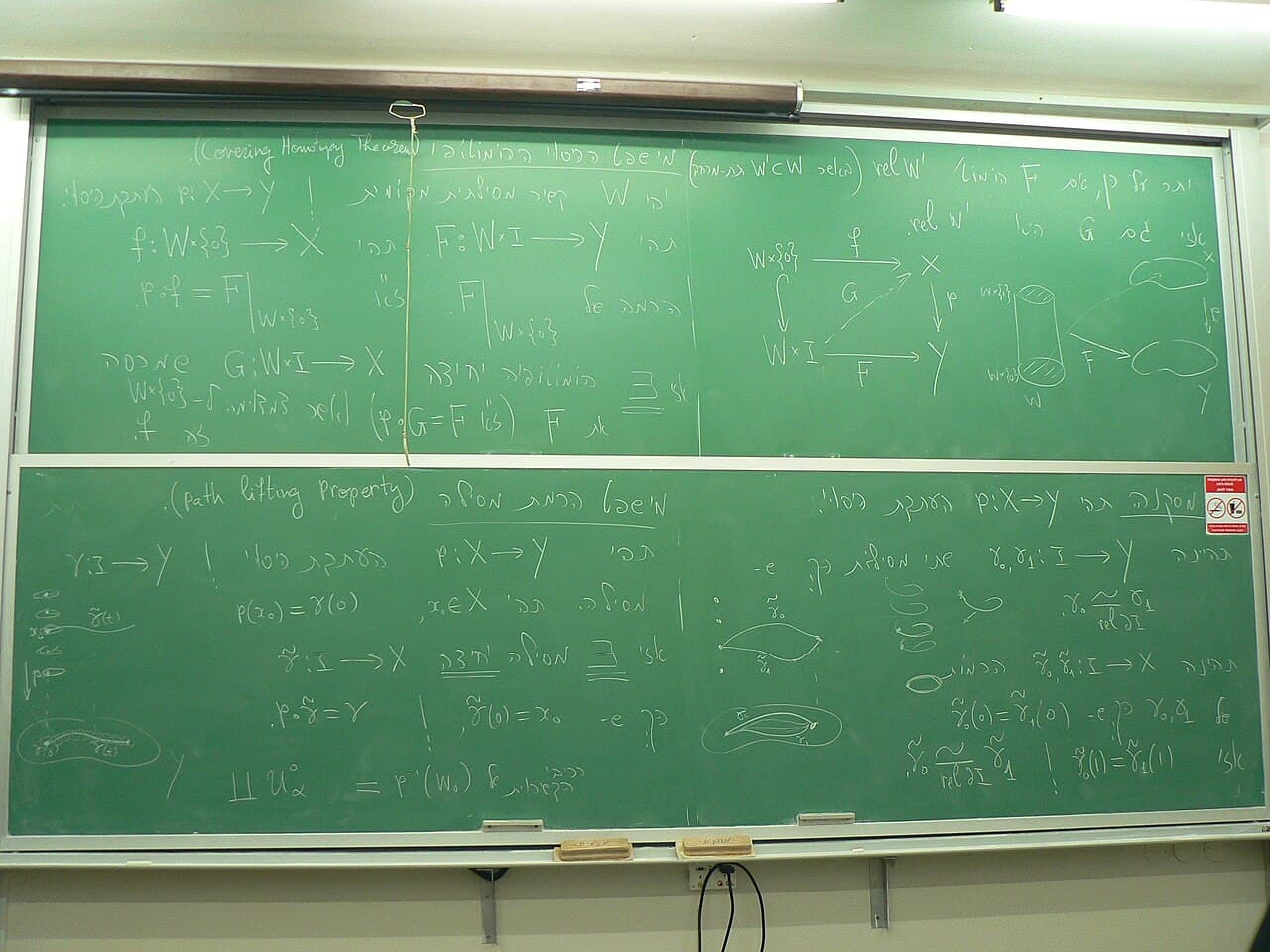
 Mathematics on a university blackboard
OLYMPIADS / YOUR NEXT CHAPTER
IOQM — Indian Olympiad Qualifier in Mathematics
For the joy of a beautiful problem.
Start exploring the mathematical olympiad pathway and develop your problem-solving foundation.
Algebraic-topology lecture at Tel Aviv University, shown as mathematics inspiration rather than an IOQM syllabus or exam venue.
Photo: MathKnight · CC BY-SA 3.0 · Displayed with responsive cropping.UNDERSTAND THE BIGGER PICTURE
Your pathway, at a glance.
Entry stage of India's Math Olympiad pathway. Qualifiers proceed to INMO, then the International Mathematical Olympiad training camp.
Know the requirements
Check the eligibility and exam-cycle information published by the conducting body.
Build your preparation
Use the official syllabus and paper pattern to guide your study plan.
Explore what follows
Mathematical problem-solving. Selection depends on the applicable programme rules.
ELIGIBILITY
Who can take this exam?
Eligibility
Open to Indian students in Class 8 through Class 12 (exact class/age windows are set by the Mathematics Teachers' Association (India) each cycle); registration is coordinated through participating schools and regional coordinators rather than by individual students directly.
Academic requirements
A strong foundation in pre-Olympiad mathematics — number theory, algebra, geometry, and combinatorics — typically built through school-level and foundation Olympiad training.
APPLICATION
Make your application count.
Application process
Registration is coordinated through the student's school or a regional coordinator recognized by the Mathematics Teachers' Association (India); there is no standalone individual online application for this stage.
PATTERN
Know what you are preparing for.
Exam pattern
A single objective paper of numerical-answer-type questions (not multiple-choice) covering Number Theory, Algebra, Geometry, and Combinatorics.
SYLLABUS
Build your subject foundation.
Syllabus
Pre-Regional Mathematical Olympiad level topics: elementary number theory, algebra (polynomials, inequalities, functional-equation basics), Euclidean geometry, and combinatorics (counting, the pigeonhole principle, basic graph theory).
PREPARATION
Prepare with a sense of direction.
Preparation strategy
Build a strong foundation across the four core areas through school-level Olympiad books and past IOQM/RMO papers, with regular timed practice on numerical-answer questions rather than rote formula recall.
CHECK THE ORIGINAL SOURCE
Dates, notices & documents.
- IOQM 2026-27 Exam DateCycle: 2026-272026-09-06
A FEW THINGS YOU MIGHT WONDER
Good questions. Clearer answers.
Which classes are eligible to appear for IOQM?
Students of Class 8 to 12 are eligible for this first stage of the Mathematical Olympiad, provided they meet the other eligibility criteria — a student who has already passed Class 12 is not eligible.
What is the IOQM exam format?
30 questions worth 100 total marks (10 questions x 2 marks, 10 x 3 marks, 10 x 5 marks), answered as two-digit integers (00-99) on an OMR sheet, over a 3-hour duration, with no negative marking.
How do I register for IOQM?
Registration is done online through the Mathematics Teachers' Association (India) website (mtai.org.in). Schools register as examination centres and enrol their students; individual students whose school isn't registered can apply directly.
Is there a registration fee for IOQM?
Yes, a modest fee that varies by school category (lower for Jawahar Navodaya Vidyalaya / Kendriya Vidyalaya students than for other schools). Later stages, for those who qualify, do not require additional fees.
Will I get a certificate just for taking IOQM?
IOQM certificates are awarded to candidates who score at or above a minimum percentile threshold set for that year — not to everyone who appears.
Can I request re-evaluation of my IOQM answer sheet?
Yes, within the re-evaluation window announced on the official site — but once marks are finalized after re-evaluation, no further changes or appeals are possible.
KEEP YOUR OPTIONS OPEN
Other paths worth exploring.
 Homi Bhabha Centre for Science Education, Mumbai
INMO — Indian National Mathematical Olympiad ↗
Proofs, reasoning & mathematical exploration
 Onion cells under a microscope
NSEB — National Standard Examination in Biology ↗
Biology olympiad progression
 Chemistry laboratory bench
NSEC — National Standard Examination in Chemistry ↗
Chemistry olympiad progression